Three Chords and a Raffle Ticket: The Club Circuit That Trained Britain's Guitarists
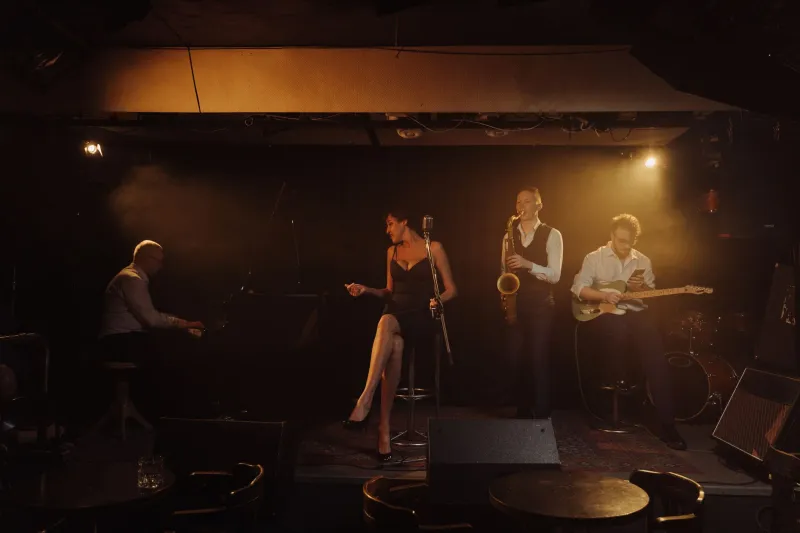
The stage is about a foot high, chipboard under a coat of gloss, and the strip light above it has never once been kind. There's a PA with two mics and a tape hiss you could lean on, a drum kit with a tea towel in the bass drum, and a carpet that smells of lager, Flash and other people's cigarettes from a decade ago. It's ten past eight on a Friday. The bingo has finished. Somebody is selling raffle tickets down the left-hand side of the room, and a guitarist is about to find out whether the twelve-bar shuffle he's been practising in his bedroom survives contact with sixty people who have already had their tea.
That room is a vanishing thing. Not entirely gone — not yet — but going, at a rate that anyone who plays the circuit will tell you has stopped feeling gradual and started feeling like a countdown.
The Man With the Diary
The most important person in British clubland was never on stage. He was the concert secretary: a bloke in a polo shirt with a hardback diary, a biro and a phone that rang during his dinner. He booked the turns, argued about the fee, decided whether your band was worth the Wednesday slot, and — crucially — decided whether you'd be asked back in six months' time.
The clubs themselves came out of the same Victorian self-improvement instinct as the mechanics' institutes, formalised nationally from 1862 through the Club and Institute Union. By the middle of the twentieth century they were the social plumbing of industrial Britain: snooker, cheap beer, a concert room, a committee, and a membership card. At their peak the affiliated clubs counted members in the millions.
For a teenage guitarist, that diary was the first real gatekeeping you ever met. Not a promoter chasing buzz, not an algorithm, not a support slot traded for Instagram reach — just a man who needed four forty-minute sets on a Saturday and wanted to know, bluntly, whether you could do the job.
Four Sets, One Raffle, No Mercy
Club work was not glamorous and it was not supposed to be. You played a first spot, the raffle happened, you played a second spot, the meat draw happened, you played a third. You did it in a shirt. You did it with a setlist built from The Shadows, Johnny Cash, Chuck Berry, Creedence, a bit of Dire Straits if the room had a few younger faces, and one modern song that the committee had specifically requested and would regret.
What that format drilled into a player is hard to overstate. You learned tempo, because there were people dancing and people dancing do not forgive a guitarist showing off. You learned dynamics, because the front tables wanted to talk and the back tables wanted to hear. You learned repertoire — not three originals and a mood, but forty songs, keyed sensibly, in a running order that meant the room never sagged. You learned how to fill a silence without panicking. You learned that a solo is a service, not a personality test.
Most of all you learned how to play to a room that isn't looking at you. Strip lights, no haze, no barrier, no phones up. Just you, the strip light, and the raffle.
Where the Riffs Got Road-Tested
There's a reason so much British guitar music carries the imprint of that circuit even when the band in question never played one. Beat groups in the early sixties worked the clubs before anyone called them beat groups. Pub rock and the blues boom ran on the same logic. And the players who went on to write the riffs that filled arenas had usually spent years learning how to hold a room containing a man in a cardigan who wanted "Wonderful Land" and wasn't shy about saying so.
That's not nostalgia talking. It's craft. A riff that works in a working men's club works because it survives a bad PA, an indifferent crowd and a room with too much glass and too little soft furnishing. It's a stress test. Plenty of celebrated guitar parts were, in their earliest form, filler between the bingo and the raffle, and they were better for it.
The 2026 Ledger
The reasons for the decline are not mysterious, and none of them are romantic. The smoking ban in 2007 took away a revenue stream and a social ritual at once. Supermarket lager undercut the bar. Committee members aged and weren't replaced. Energy bills, insurance, licensing and maintenance went one way while membership went the other. Thousands of affiliated clubs have gone since the turn of the century; the ones that remain are often running on volunteers, a function room and a Friday night that barely covers the heating.
And when a club closes, the building doesn't become a smaller club. It becomes flats, a convenience store, a nursery. The stage goes in a skip.
What Replaces the Function Room
There are substitutes, and they're worth defending: open-mic nights, small grassroots venues, arts centres, the cheerfully illegal house gig. But they're not the same proposition. An open mic gives you eight minutes and a room of other musicians. A grassroots venue gives you a door split and a sound engineer and a crowd who came specifically for the bands. Neither gives a seventeen-year-old the thing the club gave: forty minutes, four times over, to a room of strangers who paid to be there and have no interest in being polite.
The club circuit was never cool. That was the point. It was a place to be mediocre in public until you weren't, and there is no app for that.
So next time you hear a lean, unshowy, perfectly-timed guitar part and wonder where the player learned to sit in a groove like that, consider the possibility that the answer is a function room in Doncaster with a raffle and a strip light. Then consider how many of those rooms are left.
Last orders is being called. Somebody should be taking notes.