Hand-Me-Down Hooks: The Songs British Guitarists Gave Away and Never Got Back
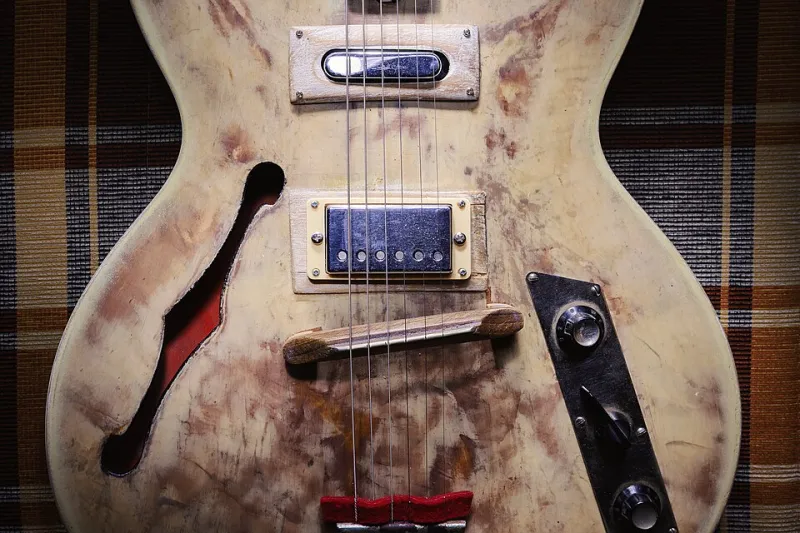
Photo: Dejan Krsmanovic, CC BY 2.0, via Wikimedia Commons
There is a particular kind of silence that falls over a pub table when someone mentions the song they gave away. It usually lasts about half a pint. Then the details arrive — who was in the room, what was said, what the advance came to — and everyone leans in, because the story of a riff that changed hands is always more interesting than the story of one that stayed at home.
British guitar music is full of these handovers. Some were generous, some were strictly business, and a few were accidents involving a rehearsal room, a cassette and a man who happened to be passing. What they share is a peculiar afterlife: the song gets famous in somebody else's hands, and the original author spends the next forty years being asked about it in interviews.
Bowie, the one-man redistribution service
Nobody handed out material with quite the enthusiasm of David Bowie in the early Seventies. Between 1971 and 1974 he operated as a sort of distribution network for other people's careers, and a fair number of the songs he passed on were built on guitar parts he had no intention of playing himself.
The famous case is Mott the Hoople. By 1972 the band were close to calling it a day, and Bowie — a genuine fan — offered them a song. By the most repeated version of events, he played them “Suffragette City” and they turned it down. He came back a day or two later with “All the Young Dudes”. Mick Ralphs hung a descending, sneering riff across it, the band recorded it, and the song that saved Mott the Hoople became one of the defining glam singles of the decade. Bowie's own version wouldn't surface for another two years, which is why a lot of people still think of it as a Mott song first and a Bowie song second.
Peter Noone got there first
Less celebrated, just as cheeky. Bowie gave “Oh! You Pretty Things” to Peter Noone — Herman's Hermits frontman turned solo act — and Noone's version charted in Britain in 1971 before most of the country had heard a note of Hunky Dory. For a few months, a Bowie song was a hit without Bowie having the hit. The guitar work is modest, all clipped chords and tidy fills, but the song's bones are unmistakable: the piano figure, the odd harmonic sidestep, the sense that something is about to come down out of the sky.
The one that went north
Lulu's 1974 reading of “The Man Who Sold the World” is the giveaway that keeps on giving. Bowie produced it, Mick Ronson played on it, and the arrangement turns a grim, chugging album track into something close to a torch song with a guitar line doing the heavy lifting underneath. It handed Lulu a top five single. Two decades later it handed Nirvana one of the most haunting moments of MTV Unplugged. Which means a song written in 1970 has now been a hit for three separate artists across three separate decades, and nobody has ever quite got the riff back.
Peter Green and the slow burn
The purists will tell you Fleetwood Mac's “Black Magic Woman” is the definitive version. The charts will tell you otherwise. Peter Green's 1968 original is a masterclass in restraint — the guitar almost sulks around the vocal, all space and shadow and no hurry. Santana's 1970 take grabbed the same song, turned up the congas and the treble, and made it a top five record in America.
Green's relationship with that song says a lot about how these handovers really work. He didn't so much give it away as leave the door open, and the wider world walked straight through. He was rarely bitter about it in interviews. The more telling detail is how often players of his generation treated a song as something closer to a rumour than a possession. Once it's out, it's everybody's.
The Suede man who said yes
Fast-forward a couple of decades and the handover gets more personal. Bernard Butler walked out of Suede in 1994 at the peak of the noise surrounding them, and rather than immediately forming another band with his own name above the door, he ended up writing with David McAlmont. The result, 1995's “Yes”, is a strange and glorious thing: a guitar part that swaggers like a Bond theme, strings doing something faintly illegal, and a vocal that starts at the ceiling and climbs.
It was a hit. It was also, in the most literal sense, a song Butler gave away — his playing all over it, someone else's name on the front of the sleeve. For a guitarist who had just left the most talked-about band in Britain, there was something almost perverse about that. It also proved a point worth remembering: a great guitar part doesn't always need a band around it. Sometimes it just needs a voice that can survive it.
Silver linings, reluctant owners
Then there's “Hi Ho Silver Lining”, a song handed around so often it's practically a folk tune. Written by Scott English and Larry Weiss, cut early by The Attack, then picked up by Jeff Beck, whose 1967 version made it a permanent fixture of wedding discos and football terraces. Beck reportedly grew to loathe it, which is either a tragedy or the most British sentence ever written. The song outlived the enthusiasm of the man who made it famous — the ultimate indignity of the giveaway.
What a giveaway actually costs
The romantic version of these stories is about generosity: the older hand helping out, the mate who needed a song, the writer with one to spare. That happens, genuinely. But the handovers that last tend to have a business shape underneath them — a publishing split, a production credit, a favour owed, a label wanting something shiny for a new signing.
And then there's the cost that never appears in a contract: the rest of your working life spent being asked about the song you didn't keep. Most players seem to make their peace with it. A few clearly never do. Either way the record stays the same — somebody's riff, somebody else's hit, and a story that improves with every retelling.
Maybe that's the real trade. You lose the song. You get the anecdote.