The Pavement Soundcheck: Britain’s First Listen Happened Outside
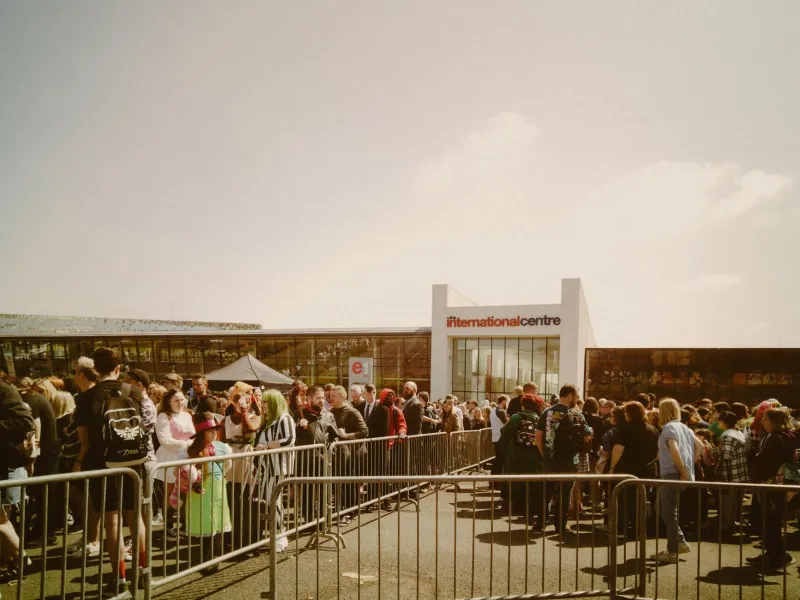
The best sound in Britain has always been the one you weren’t supposed to hear. Not the mixed, monitored, front-of-house version — the other one. The one bleeding through a fire door while you stand in a queue with a warm can and a pocket full of nothing.
The fire door is the first support act
Every regular knows the ritual. You arrive early — earlier than the ticket suggests, earlier than your mates — and you get in line. For the next hour, the headliner soundchecks for you through a propped-open door, a ventilation grille, or a wall thick enough to swallow the cymbals but not the bass. Whether it’s a converted cinema in south London or a ballroom in Glasgow, the acoustics of the pavement are remarkably consistent: low end first, vocals lost, hi-hats reduced to a hiss.
A riff heard through brick is mostly a rumour. The bass and the kick drum arrive before anything else; the guitar is there, but it’s been sanded down by architecture. What survives is rhythm and intent. You hear the shape of the song before you hear the song. And that is a strange and useful education. The queue taught a generation to listen structurally — to identify a tune from three chords and a drum pattern, to work out where the chorus would land, to argue about whether the new material sounded heavier than the last album. It’s how plenty of us learned that a great riff is a rhythm first and a melody second.
The setlist economy of the pavement
Information moved differently in a queue. Someone always had a mate on the crew, or a photocopy of the running order, or a cousin who’d seen the previous night in Leeds. Setlist scraps passed down the line like relics: a torn page, a screenshot printed out at work, a support act’s timings scrawled on the back of a fag packet. None of it was official. All of it was currency.
The queue was a rumour mill with a common purpose. You learned which songs had been dropped, which new ones were still shaky, whether the guitarist was playing the Les Paul or the Strat. You heard the same four bars repeated while the desk fixed a DI box, and you convinced yourself it was a sign. Half the time it was just a line check. But the anticipation did something to the ears. By the time the doors opened, you weren’t going in cold. You’d already heard the gig in outline.
Spares, chips and the grammar of hope
Then there were the ticketless. The hopeful stood at the corner with a finger in the air, mouthing the word “spares?” like a prayer. The queue had its own moral code: hold a place, share a lighter, don’t grass on the bloke with the hip flask, and never pretend you’ve got a spare when you haven’t. Friendships were formed over a portion of chips and a shared suspicion that the support act would be better than the headliner.
That social apprenticeship is harder to replicate online. A forum thread can tell you the setlist, but it can’t tell you what the bass sounded like through a fire door while the rain came sideways and someone’s mate did an impression of the singer. The queue was a place where you learned how to be at a gig before you were at a gig.
The hour before the hour
In 2026, the queue has been quietly reorganised. Timed-entry tickets, staggered slots, digital queues and phone-based anticipation have thinned out the shared hour on the pavement. You arrive at 19:42, you scan, you’re in. It is efficient, and nobody misses the crush. But something has gone with it: the collective listening, the passing of information, the accidental friendships, the sense that the night began the moment you joined the line.
The old ways survive in smaller rooms — the pub venues and back rooms where doors still open late and the soundcheck runs over. There, the fire door still leaks a riff into the street, and someone still stands outside with a finger in the air. For now.
The riff you never quite heard
The joke is that the muffled version was often better. Through a door, a new song sounded heavier, stranger and more promising than it ever did once the vocals came up in the mix. The queue was Britain’s informal apprenticeship in gig-going, and it taught you something no stream can: that anticipation is a sound. You heard it first on the pavement, half-heard and more exciting for it.