The Snap Heard Round the Room: Britain's Mid-Gig String Break and the Unwritten Rules of Recovery
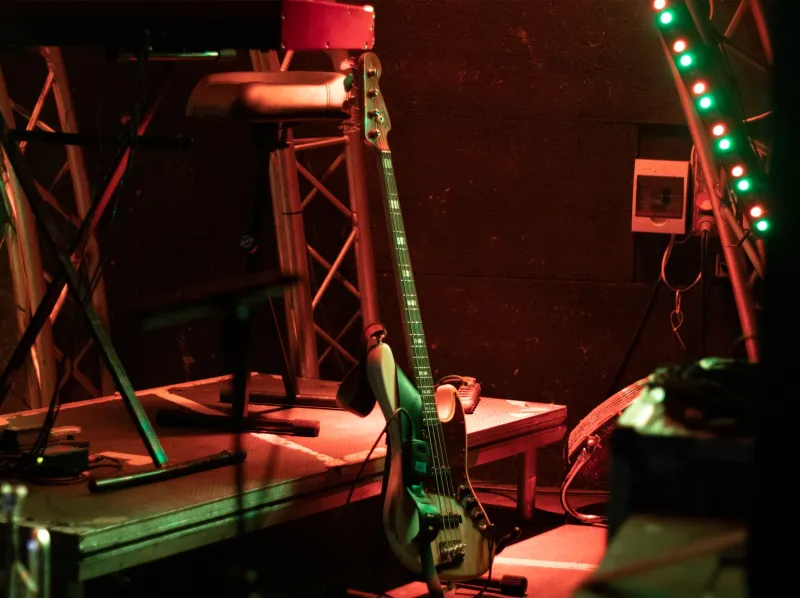
At 9.42pm on a Friday in a room above a pub in Tunbridge Wells, a G string gives up. Not with a whimper — a bright, cartoonish ping that cuts through the monitors and lands somewhere near the front row. The guitarist looks down at his hand as if it has personally betrayed him. The singer, bless him, keeps going. And the room, for about four seconds, does something rare: it holds its breath.
The Sound of a Small Disaster
A broken string is a tiny mechanical failure with outsized social consequences. It is also, if we are honest, one of the last genuinely unscripted things that can happen at a guitar gig. No one has rehearsed the recovery. There is no click track for the moment the third string snaps during the second chorus and the band has to decide, in real time, whether to stop, soldier on, or turn the whole thing into a bit.
In a big room, the machine absorbs it. A tech appears from the wings like a pit-stop mechanic, a spare guitar is already in tune, and the show barely stutters. In a small room — the 100 Club, the Brudenell, a function room in Chester with a carpet that smells of old beer — the break is everybody's problem. The guitarist has no tech. The spare guitar is in the van, and the van is round the back, and the keys are in the singer's jacket. This is where the rituals begin.
Why the Third String Takes the Blame
Ask any guitarist which string breaks and they will say the third, and they will say it with feeling. On an electric, the G is the thinnest of the wound strings, which means it lives its life on the edge: bent, choked, vibrato'd, and generally asked to do the emotional heavy lifting of the entire solo. On an acoustic, the G is plain steel, and it tends to go at the saddle or the tuner, often with a sound like a small firework.
There is a practical reason, then. But there is also a folkloric one. The third-string break has become a kind of omen, and players have built entire belief systems around it. Some change the G before every gig, no arguments. Others refuse, on the grounds that a string has its own time and interfering is bad luck. One player I know swears that a break in the first three songs means a good night; another insists it is a warning and spends the rest of the set playing like a man defusing a bomb. Neither has any evidence. Both are absolutely certain.
Taped Spares and the Borrowed-Wire Economy
The oldest ritual is the spare string taped to the back of the headstock, or coiled in the lid of the gig bag, or wedged behind the nut like a tiny talisman. It is a small act of pre-emptive faith: I will not need you, but I will bring you anyway. Some players carry a full set. Some carry one lonely string, usually the wrong gauge, usually a G.
Then there is the borrowed-wire economy. Support bands lend strings to headliners and vice versa, and the transaction is governed by an unwritten code. You ask the other guitarist's gauge. You accept whatever you are given. You offer to repay it at the next gig, and you both know you probably will not, and that is fine, because the debt is the point. The phrase 'I owe you a string' has been said in British dressing rooms so many times it ought to be on a plaque.
And then the sprint. Someone remembers that the bloke in the support band has a spare in his case, or that the venue's sound engineer keeps a drawer of odds and ends, or that there is a guitar shop two streets away that closes at six but might, just might, still be open. The whole room watches the door. The singer tells a story. The drummer does a little fill. Time stretches.
The Kneeling Restring
The backstage restring is its own genre of performance. The guitarist kneels, one knee on the sticky carpet, guitar across the thigh, phone torch clamped in the mouth. The winder is missing, so it is done by hand, which takes longer and hurts more. The singer is instructed, in a stage whisper, to 'keep talking'. The singer does not need to be told twice.
Outdoors, the ritual moves to the car park: tailgate down, string packet between the teeth, a stretch-and-tug to settle the tuning that never quite settles. There is a particular British stoicism to the roadside restring — the cold hands, the bad light, the knowledge that the gig is waiting and the audience is getting another pint. It is not glamorous. It is, in its way, the most honest part of the night.
The Superstitions
Every guitarist has a string ritual, and most of them are nonsense. New strings on the day of the gig, or never new strings on the day of the gig. A lucky setlist. A particular order of tuning. The insistence that you never, ever say the words 'last song' out loud until the last song is actually over. The belief that a break in the encore is a sign the crowd deserves one more, or a sign that the universe is telling you to go home.
The third string gets its own lore. Some players will not bend the G in the first song. Some will not play a G chord at all until the second verse. One veteran told me he had not broken a string in twenty years, and when I asked his secret he said, without a trace of irony, 'I change it before the show and I do not think about it again'. That is not a technique. That is a prayer with a peg winder.
Five Strings and a Story
Here is the thing about a broken string: nobody remembers the solo you nailed. They remember the night the string went and you carried on with five, or the night you pulled the broken end out of the way and played the rest of the song on the remaining strings like a man who had planned it all along. There is a long and noble tradition of the one-string solo, the five-string chord, the improvised slide with a bottleneck that happened to be on the amp.
The crowd is on your side in that moment. That is the secret. A broken string humanises a guitarist in a way no amount of stagecraft can. For thirty seconds, the person on stage is not a hero; they are someone kneeling on a carpet with a phone in their mouth, trying to thread a piece of wire through a tiny hole while two hundred people wait. And then they stand up, hit the chord, and the room roars.
The snap is the last unscripted thing. Long may it ping.