The Three-Chord Handshake: What British Guitarists Play When Nobody’s Listening
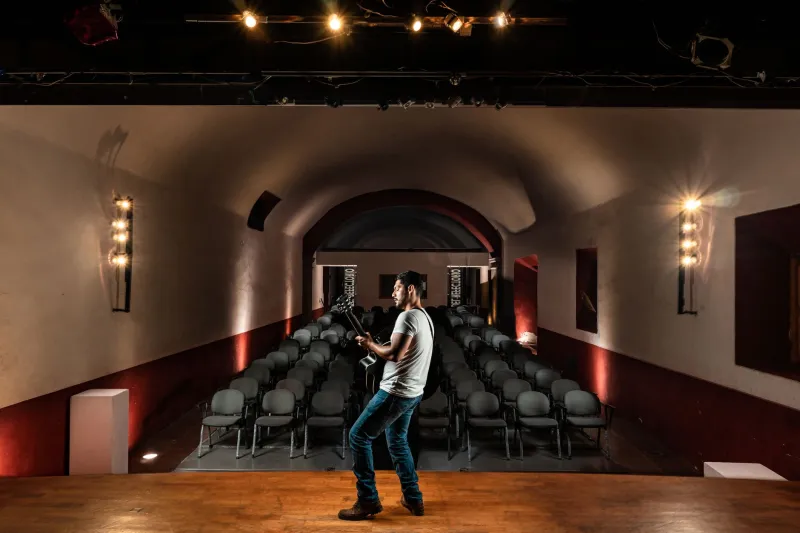
The sound of an empty room
It is 6.40pm in a village hall somewhere off the A38. The chairs are still stacked, the PA is crackling into life and a guitarist is standing too close to a valve amp that is not quite warm. The vocalist has already done the ‘check, one-two’. Now it is the guitar’s turn. And out comes the riff. Not a song, exactly. Not a rehearsal. Just the same three-chord phrase that has been played in a thousand British back rooms, working men’s clubs and festival production tents.
The soundcheck riff is one of the least documented rituals in guitar culture. It is not on the setlist. It is not meant for an audience. But it is strangely revealing. Before anyone has heard a note of the actual gig, the warm-up has already told the engineer, the roadie and anyone loitering by the bar what kind of player has turned up.
A stethoscope with strings
At its most practical, the soundcheck riff is a diagnostic tool. The guitarist is not trying to entertain; they are trying to hear what the room is doing to the amp. A familiar phrase isolates variables. If the player uses a shape they know inside out, any oddity – a fret buzz, a dead string, a muddy low end, a brittle top – stands out immediately.
That is why certain riffs become universal testing grounds. They are simple enough to play while listening, recognisable enough to give the engineer something to work with, and varied enough to show up problems. An open chord tells you about tuning. A pentatonic run tells you about fretboard response. A chunky power-chord riff tells you whether the room is swallowing the mids or bouncing them back at the stage.
The guitarist is not showing off. They are checking the pipes.
The usual suspects
Ask any British guitarist what they play at soundcheck and the same names surface. The riff from ‘Smoke on the Water’ is the eternal default: instantly recognisable, easy to modulate and almost impossible to play badly enough to embarrass yourself. It is the handshake of the amateur and the professional alike.
Then there is ‘Whole Lotta Love’, all swagger and space, useful for hearing how an amp responds when you dig in. ‘Back in Black’ tests timing and restraint. ‘Paranoid’ checks whether the low end is tight or turning to soup. ‘You Really Got Me’ is a British punch test – sharp, immediate, and unforgiving of a soft attack.
Younger players bring their own defaults. The riff from ‘Do I Wanna Know?’ checks sustain and tremolo. A bit of ‘Plug in Baby’ tests whether the guitar can cut through a digital desk. ‘Seven Nation Army’ is now so ubiquitous that it has become a kind of festival line-check standard, a riff that can be heard drifting across fields long before the gates open.
None of these choices are random. They are calibrated. They are the phrases a guitarist trusts when the room is empty and the clock is ticking.
The confession in the riff
But the soundcheck riff gives away more than the state of the amp. It exposes the player’s influences. A guitarist who warms up with a Clapton-esque blues lick is telling you something different from one who runs through a Johnny Marr jangle or a Mastodon-style down-picked riff. The warm-up is a résumé written in muscle memory.
It also reveals experience. The bedroom player tends to play too much, filling every gap with notes. The gig-hardened player plays less, listens more and stops abruptly when the engineer asks for ‘a bit of the low E’. There is a whole social language in that pause.
And then there is the apology. ‘That’s just the guitar,’ the player says after a particularly loud test chord, as if the instrument has been caught doing something rude. It is a very British reflex: the soundcheck is a necessary intrusion, and the guitarist is vaguely sorry for making a noise in an empty room.
From back room to festival field
The ritual has survived because it works. In a pub back room with a low ceiling and a sticky carpet, the soundcheck is a slow negotiation with a room that was never designed for live music. In a festival production tent, it is a line check against a digital desk and a monitor mix that changes every five minutes. The scale changes; the riff does not.
In 2026, guitarists can model a dozen amps on a laptop and send their signal through a system that would have baffled a 1970s roadie. Yet the instinct remains: plug in, turn up, play the thing you know. The empty room does not judge. It just tells you what it is going to do to your sound.
So the next time you hear that familiar riff drifting out of a venue before the doors open, don’t think of it as a song. Think of it as a password. The guitarist is checking the room, the rig and themselves. And in a small way, they are saying: I’m here, I’m ready, and I’m one of you.