Four Minutes, No Announcement: The Secret Code of the One-Song Cameo
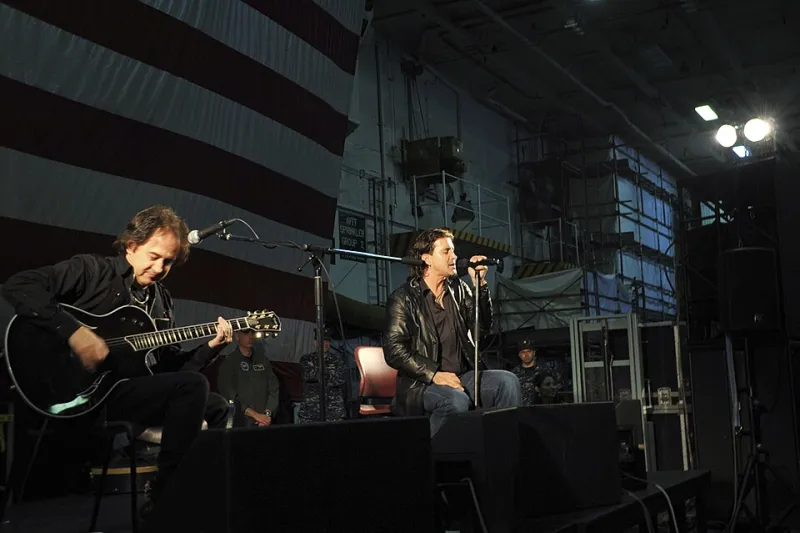
Photo: Official Navy Page from United States of America MCC (SW/SCW/AW/PJ) Ryan Delcore/U.S. Navy, Public domain, via Wikimedia Commons
The house lights are still down. The band is three songs from the end, the singer is doing the bit where he thanks the support act, and a figure slips out from stage left with a guitar already strapped on. No introduction. No name check. Just a nod to the drummer, a count-in, and four minutes of something the room did not pay for and will not forget.
The unannounced guest spot is one of the oldest tricks in British live music. It happens in 150-capacity backrooms above pubs, and it happens in arenas where the guest arrives through a tunnel with a security guard who has been told precisely nothing. It is rarely advertised, often unrehearsed, and almost always over before the audience has worked out whether it was actually who they thought it was.
The Whisper Before the Walk-On
There is an etiquette to this, and it is mostly unspoken. The guest does not ask to play. The band does not announce that the guest will play. Someone's guitar tech has already put a spare amp on the riser, angled slightly away from the drum kit, with a lead coiled beside it like a question mark. The guest has been at soundcheck, or has not been at soundcheck, and in either case has been told the key and the ending.
The crucial part is that nobody makes a fuss. In a small venue the guest might come through the crowd with a gig bag over one shoulder and a pint in the other hand. The door staff know. The bar staff half-know. The audience works it out roughly eleven seconds before the first chord, which is exactly the right amount of notice.
Why One Song and Not Two
Two songs is a support slot. Three is a co-headline. One song is a rumour.
The brevity is the whole point. A single number gives the room a jolt without rewriting the night's running order. It protects the headline set's momentum, which is a real and fragile thing, and it protects the guest from the slow death of a second song that nobody quite knows. It also keeps the story small enough to be repeated accurately, which is the only kind of story that survives.
In 2026 the artefact is usually a vertical phone clip, slightly out of focus, with the bass drum clipping the audio. The clip is not the point. The clip is the receipt. The point is the collective intake of breath when the extra guitar comes in on the second verse and the person next to you says, quite loudly, 'That's not the guy from the support act.'
The Rooms Where It Happened
There is a particular version of this that belongs to the club circuit. The Brudenell in Leeds. The Joiners in Southampton. A back room in Stoke with a low ceiling and a stage that is really just a slightly raised section of floor. The guest is a local hero, or a touring mate, or someone who used to be in the band before the band got good. They play one song, they grin at the drummer, and they are back at the bar before the chorus has finished ringing out.
The arena version is more choreographed and somehow less believable. The lights dip. The singer says something vague about a friend in town. A figure appears at the top of the stairs, guitar in hand, and the crowd makes a noise that is half recognition and half disbelief. Two minutes later the figure is gone, and the singer is pretending it was nothing, which is the surest sign that it was something.
The Vanishing Is the Trick
The guest does not take a bow. The guest does not hang about for the encore. The guest is gone before the house lights, sometimes before the last note has decayed, and that disappearance is what turns a nice moment into a piece of folklore.
A guest who stays becomes a collaborator. A guest who leaves becomes a ghost. The audience is left with a setlist that does not quite match the ticketing, a memory that needs a second opinion, and the faint suspicion that they have been let in on something that was never officially happening.
That is the trade. The band gets a shot of adrenaline and a story. The guest gets a pint, a favour in the bank, and the pleasure of playing without having to carry the night. Nobody gets paid. That is not a bug. It is the entire economy.
Why Four Minutes Outlives a Tour
A tour is a schedule. A cameo is an event. The tour has a poster, a merch table and a set of reviews that all say roughly the same thing. The cameo has none of that, which is why it keeps getting retold.
It also asks a question that a normal gig does not ask. Who else is in the building? What else might happen? That low hum of possibility is the difference between a night out and a night you talk about for years. The best one-song cameos do not just add a guitarist. They add a small, permanent doubt to every future gig: maybe tonight.
And when it does happen, it is never the song you expect. It is the one the band has been playing for a decade, suddenly played by five people instead of four, with a stranger's fingers on the fretboard and a room full of people leaning forward at the same time. Then it is over. The house lights come up. The guest is already outside, walking to the van, guitar case in one hand and nothing else to prove.