The Buzz Before the Riff: Britain’s Mains Noise and the Amps That Sang With It
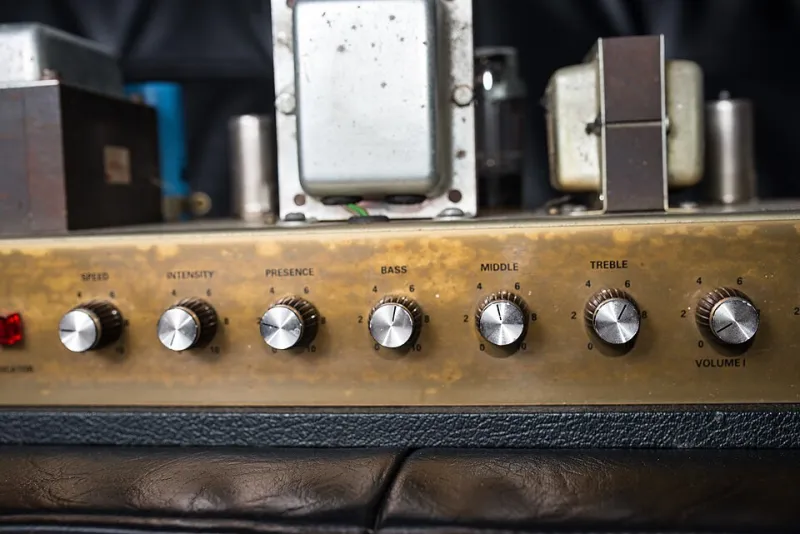
Photo: Shixart1985, CC BY 2.0, via Wikimedia Commons
There is a moment before the riff. The guitar is plugged in, the amp is switched on, and the room holds its breath. Then comes the hum. Not always loud, not always clean, but unmistakably there: a low, electrical murmur from somewhere behind the speakers. In Britain, that sound has a particular character. It is the sound of 240 volts and 50 hertz meeting a building that was never designed with rock’n’roll in mind.
For generations of guitarists, the hum is not simply a fault. It is a venue report. It tells you whether the pub cellar has been rewired since the smoking ban, whether the church hall’s sockets share a circuit with the kitchen urn, and whether the dimmer switch by the stage is going to behave itself. It is the mains noise that precedes the music, and in its own strange way, it has become part of the national guitar sound.
The Room Enters the Amp
British gigging has always been an electrical negotiation. Village halls, working men’s clubs, upstairs rooms above pubs, scout huts and converted churches were not built to host valve amps and pedalboards. Many were wired for fluorescent lights, tea urns and a single socket near the piano. The ring main might be ancient; the earth might be present in theory and absent in practice; the stage power might come from an extension lead that has seen three decades of Christmas fairs.
Into this arrives a guitarist with a valve amp, a handful of pedals and a single-coil pickup that behaves like an aerial for every electrical complaint in the building. The result is the familiar 50Hz hum: a low fundamental around the G below the guitar’s bottom E, plus a constellation of harmonics that can make it sound like a buzz, a drone or a distant wasp trapped inside the speaker cabinet. It is not the guitar’s fault, exactly. It is the room entering the signal path.
Dimmers, Fridges and the Ghost in the Circuit
Ask any jobbing guitarist about the worst hum they have heard and you will get a geography of British venues. The pub cellar where the lights were on a dimmer and the amp buzzed in time with the landlord turning them down. The church hall where the fridge in the kitchen clicked on halfway through the second song. The club where the neon sign outside shared a circuit with the stage and added a nasty top-end fizz to every clean passage.
Earth loops are another classic. When two pieces of equipment are earthed at different points, the mains can find a path through the audio cables, and the amp lets you know. Sometimes the fix is simple: plug everything into one socket, use short leads, avoid daisy-chaining three extension reels across a stage. Sometimes it is not simple at all, and the guitarist spends the soundcheck crouching behind the amp, lifting a ground lift on a DI box and hoping the room does not notice.
The old advice still applies: do not defeat the earth on a mains plug. It is there for a reason. The practical fixes are less dramatic — a mains conditioner, a noise gate, shielded cables, humbuckers instead of single coils, a dummy coil, or simply standing in a different spot and letting your body absorb some of the interference. None of these are glamorous. All of them are part of the craft.
The Key of the Building
What makes the British version of this story distinctive is how often the hum became part of the performance. In a small room, with a valve amp at the edge of breakup, the 50Hz note can sit under the music like a drone. Guitarists noticed. Some tuned to it, or at least learned which pedals made it worse. Others used it as a cue: if the hum changed pitch when the fridge kicked in, the room was alive. If it disappeared entirely, something had gone wrong — or, more likely, something had finally gone right.
There is a particular silence when the hum stops. The amp is still on, the guitar is still in hand, but the electrical weather has cleared. The first chord lands with a clarity that feels almost suspicious. For a second, the room is not a building with wiring problems. It is just a room with a riff in it.
The Honest Amp
In 2026, plenty of guitarists use modellers, amp sims and digital rigs that are quieter than a library. That is a good thing for many stages. But there is still a place for the honest amp that tells you where you are. The buzz is not a virtue in itself, and nobody misses a genuinely dangerous socket. But the mild, manageable hum of a British pub gig is a reminder that the music is happening in a real place, with real electricity, shared with a landlord, a bar staff and a room full of people who have paid to stand near a radiator.
The riff may be the point. But the hum is the handshake. It is the sound of the building leaning in before the first chord, and of a guitarist saying, quietly, through the noise: right, then. Let’s see what this room can do.