Sixty Quid and a Bad Attitude: The Guitars That Rewired Britain
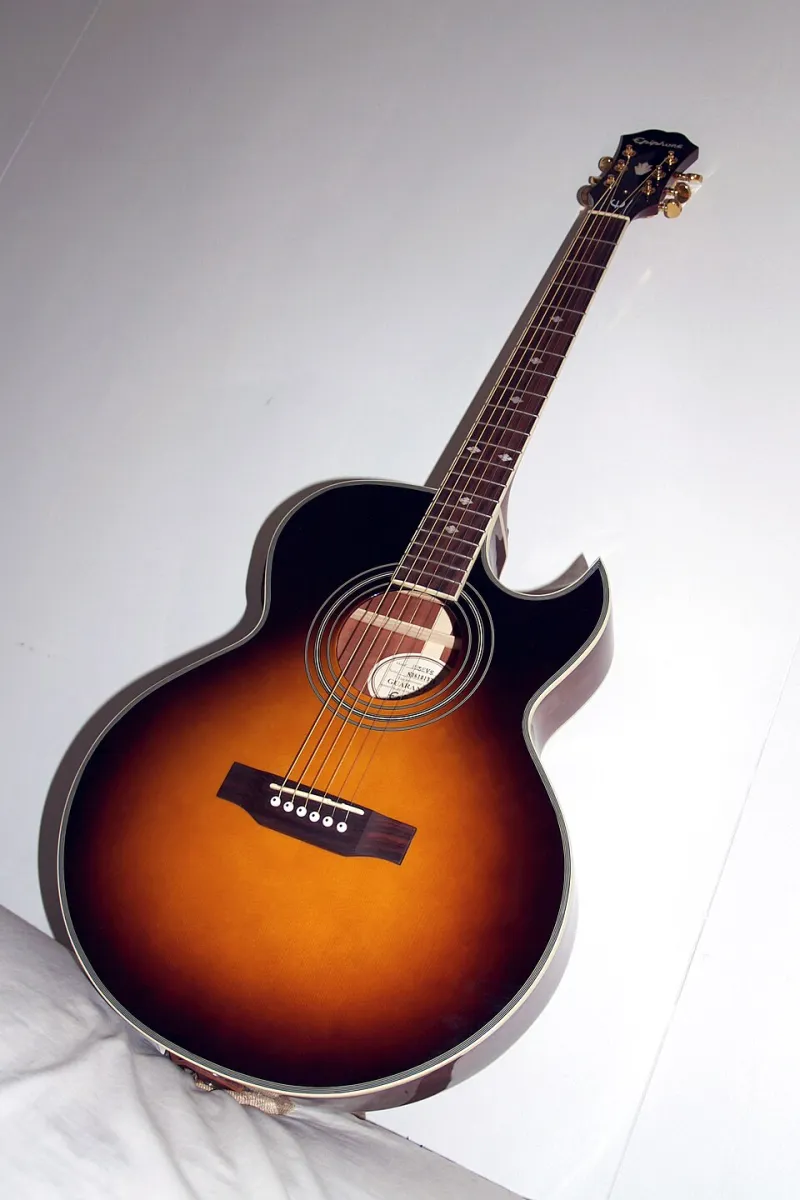
Photo: Joshu∆ Byrd, CC BY 2.0, via Wikimedia Commons
Fifty years ago this summer, a generation of British teenagers worked out that the guitar in the shop window wasn't a monument. It was a tool — and a fairly crude one at that. Half a century on from 1976, punk's budget fretboards are usually reduced to a joke about three chords and a safety pin. That does the gear a disservice. Strip away the mythology and what's left is a story about access: about what happens when the price of admission to making a noise suddenly collapses.
The instrument was never the point
In 1976, technique was suspect. The extended solo was regarded as a form of showing off, and showing off was what the bloke in the cap with the double-neck did. If you weren't meant to be good, you certainly weren't meant to spend six months' wages proving it. That logic ran all the way down to the hardware. A guitar that refused to stay in tune, buzzed like a wasp in a jar and fed back at the first sight of a loud room wasn't a handicap. It was a personality.
That's the bit that gets lost. The cheap guitar didn't merely make punk affordable — it shaped how punk sounded. Thin pickups, slack strings, badly-cut nuts, amps pushed past the point of good behaviour: this is the sonic signature of the era, and most of it was an accident of budget rather than a design decision.
What was actually hanging in the window
It's worth being specific, because the romance tends to blur the reality. The first-wave guitar was rarely a Fender anything. More often it was a catalogue instrument bought on hire purchase, or something with a name nobody remembers: Kay, Jedson, Antoria, Columbus, Hondo, Satellite. Woolworths sold guitars. So did department stores and the small ads in the back of the local paper. A teenager with a Saturday job and a patient parent could be in business by the weekend.
Second-hand shops did the rest. A Les Paul Junior with a repaired headstock for under a hundred quid. A Watkins or a Selmer combo with a torn grille cloth and a scratchy volume pot. An AC30 that had been gigged to death and smelled faintly of pub carpet. Amps were frequently shared between bands, sometimes lent, occasionally borrowed with a vagueness about when they'd go back.
“We didn't know it was supposed to be difficult”
Ray Kelleher, who played in a Sheffield band from 1976 and still keeps the guitar he started with, remembers the learning curve as no curve at all. “Nobody told us the action was too high or the intonation was out,” he says. “You just played it. If it hurt your fingers, you played it more. It never crossed my mind that the guitar was the problem. I assumed it was me, and I assumed that was normal.”
That assumption turns out to have been liberating rather than crushing. A generation of players developed a style built on rhythm, attack and volume because that's what the instrument rewarded. Subtlety was not on the menu. When the guitar fought back, you hit it harder.
The view from the repair bench
Terry Vance has fixed guitars in the East Midlands since 1979, and he's spent four decades dealing with the long tail of that era. “The same faults came in, week after week,” he says. “Frets worn into trenches. Pickups gone microphonic. Someone had swapped the volume pot for whatever was loose in the shed, so the guitar went from silent to full throttle in about two millimetres of travel. Tremolo arm missing, replaced with a bent screwdriver, or a bit of coat hanger. And it still got played, that's the thing. Nobody booked it in for a setup, because a setup cost more than the guitar.”
What Vance describes is a kind of folk engineering: instruments kept alive by improvisation because replacement was unthinkable. It's also why so many of those guitars ended up in skips by 1982, and why the survivors are now curiously valuable.
The inconvenient truth about the legend
Not everyone was playing a plank. Quite a few of the names at the centre of it all had decent instruments, and the records were made in proper studios with proper engineers. Punk's sound was never purely a by-product of poverty — plenty of it was careful, deliberate and expensive to get right.
But the door was open, and that's the point. Whether or not every band exploited it, the idea took hold: the instrument is not the gatekeeper. You don't audition for the right to start.
Why the sixty-quid guitar still matters in 2026
Walk into any guitar shop in Britain this winter and the entry-level market tells the same story, just with better quality control. Squier's cheapest offsets, Harley Bentons ordered direct, EastCoast and Vintage models hanging in provincial shops: you can buy a genuinely playable instrument for less than the cost of a weekend away. It will stay in tune better than anything built in 1976, and it will still be sneered at by somebody on the internet.
Ignore them. The advice hasn't changed in fifty years, only the prices have:
- Buy the cheap guitar that stays in tune and feels right in your hands, not the one with the best spec sheet.
- Budget for a proper setup. Forty quid at a local repair shop will transform a £180 instrument more than another £180 on the guitar will.
- Spend your money on a small amp or a decent modeller rather than a pedalboard you can't use yet.
- Borrow before you buy. Every scene has a mate with a spare combo and a drawer of forgotten leads.
- Play it in a room with other people in it, as soon as you possibly can. That's the bit no gear will do for you.
Fifty years ago, the argument was that you didn't need a fortune to matter. It was true then, and it's true now — the only difference is that the cheap guitars have got better and the excuses have got thinner. The riff was never a test of what you'd spent. It was always just a way of saying you were here.