Eyeliner on the Fretboard: How Glam Rock Made the Guitarist a Part to Play
The received history of the guitar hero is a story about hands. Woodshedding, scales, the endless pursuit of technique. But glam rock proposed something else entirely: that the guitar hero could be a part you play, not just a skill you display. On Top of the Pops in the early Seventies, the guitar break was not simply a moment to show off — it was a scene, a costume change, a wink at the camera. And in Britain, where the dressing-up box has always been as important as the practice amp, that idea stuck.
The Les Paul in the Dressing Room
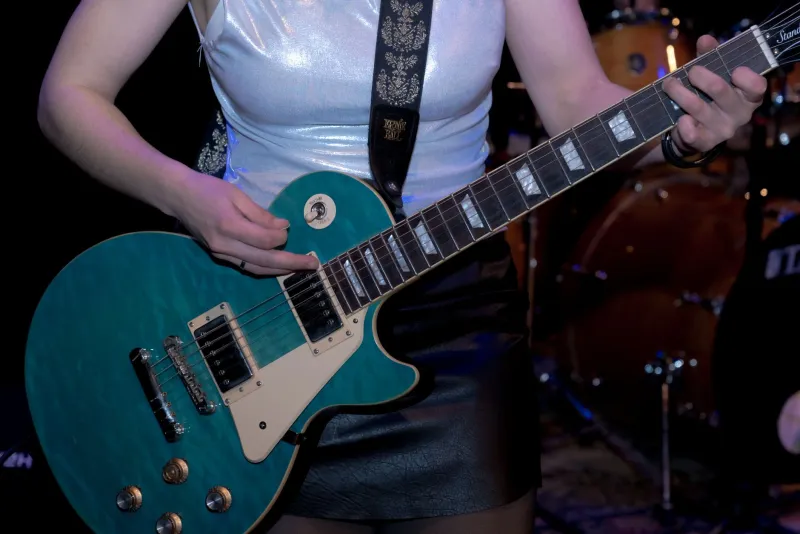
Marc Bolan understood this before almost anyone. His Les Paul, slung low and often paired with a feather boa or a glittering jacket, was not a piece of laboratory equipment. It was a prop in the best sense: something that told you who he was before he played a note. Bolan’s riffs were rarely complicated. ‘Ride a White Swan’ and ‘Get It On’ built their power on repetition, swagger and space. The guitar was there to strut, not to sprint.
Mick Ronson arrived from a different direction — a Hull lad with a classical background and a gift for arrangement — but he ended up in the same theatre. As Bowie’s foil in the Spiders from Mars, Ronson’s Les Paul Custom became a visual anchor: the sensible, slightly stern instrument in the middle of a pantomime. His solos were melodic, architectural and short. He was not trying to outshred anyone. He was trying to make the song land, and to look like he belonged in the picture while doing it.
Three Minutes on Top of the Pops
The evidence is in the television clips. When Bowie performed ‘Starman’ on Top of the Pops in July 1972, the moment that lodged in the national memory was not a virtuoso display. It was Ronson’s solo — brief, bright and full of personality — and the famous arm draped around Bowie’s shoulder. The guitar break was a piece of staging. It said: this is a band, this is a character, this is a world you could step into.
Bolan’s Top of the Pops appearances worked the same way. ‘Get It On’ was not a showcase for technical fireworks; it was a lesson in how to make three chords feel like an event. The riff was simple enough to hum in the playground and strange enough to annoy your parents. That combination was the point. Glam’s guitarists understood that a riff people can imitate is more powerful than a solo they can only admire.
The Solo as Scene, Not Scale
None of this is to say glam guitarists couldn’t play. Ronson’s arrangements were sophisticated, and Bolan’s best songs had a swing and a bite that were entirely deliberate. But the values were different. The solo was not a test of speed; it was a dramatic beat. It had to fit the costume, the set, the pose.
That is why glam’s guitar heroes often feel closer to actors than athletes. They were playing roles. Ronson was the serious, slightly menacing lieutenant; Bolan was the impish ringmaster. The guitar was how they delivered their lines. In a decade that would soon fetishise technique through prog and shred, glam insisted that identity mattered more than dexterity.
A Character You Could Dress Up As
The legacy of that idea is everywhere in British guitar culture. Punk took the dressing-up box and filled it with safety pins. The New Romantics swapped Les Pauls for synthesisers but kept the theatrical instinct. Goth, Britpop and the entire festival circuit have all borrowed from glam’s basic proposition: the guitarist is a character, and the audience is invited to try the costume on for size.
In 2026, that proposition looks remarkably current. The most visible young guitarists in Britain are not necessarily the fastest. They are the ones with a clear persona — a look, a story, a way of holding the instrument that reads instantly on a phone screen. The short-form clip has replaced the Top of the Pops slot as the place where a guitarist becomes legible, and the same rules apply. A thirty-second solo can still be a scene. A riff can still be a costume.
The Persona Is the Entry Point
There is a temptation to mourn the lost art of the long solo, but glam suggests that the trade-off was never quite as simple as technique versus image. The point was access. Bolan and Ronson made the guitar hero seem like something you could become, not something you had to spend a decade qualifying for. That is why their influence has outlasted so many more technically gifted players. They gave people a role to play.
In 2026, British guitar culture still runs on that promise. The bedroom guitarist with a ring light and a strong sense of self is not a dilution of the tradition; they are its direct descendant. The riff that wore lipstick was never just about makeup. It was about making the guitar a character — and letting the rest of us have a go.
So when we talk about glam’s legacy, we should talk less about scales and more about staging. The real inheritance is not a lick or a pedal. It is the permission to perform, to dress the part, and to treat the guitar as something you step into rather than something you simply master.